
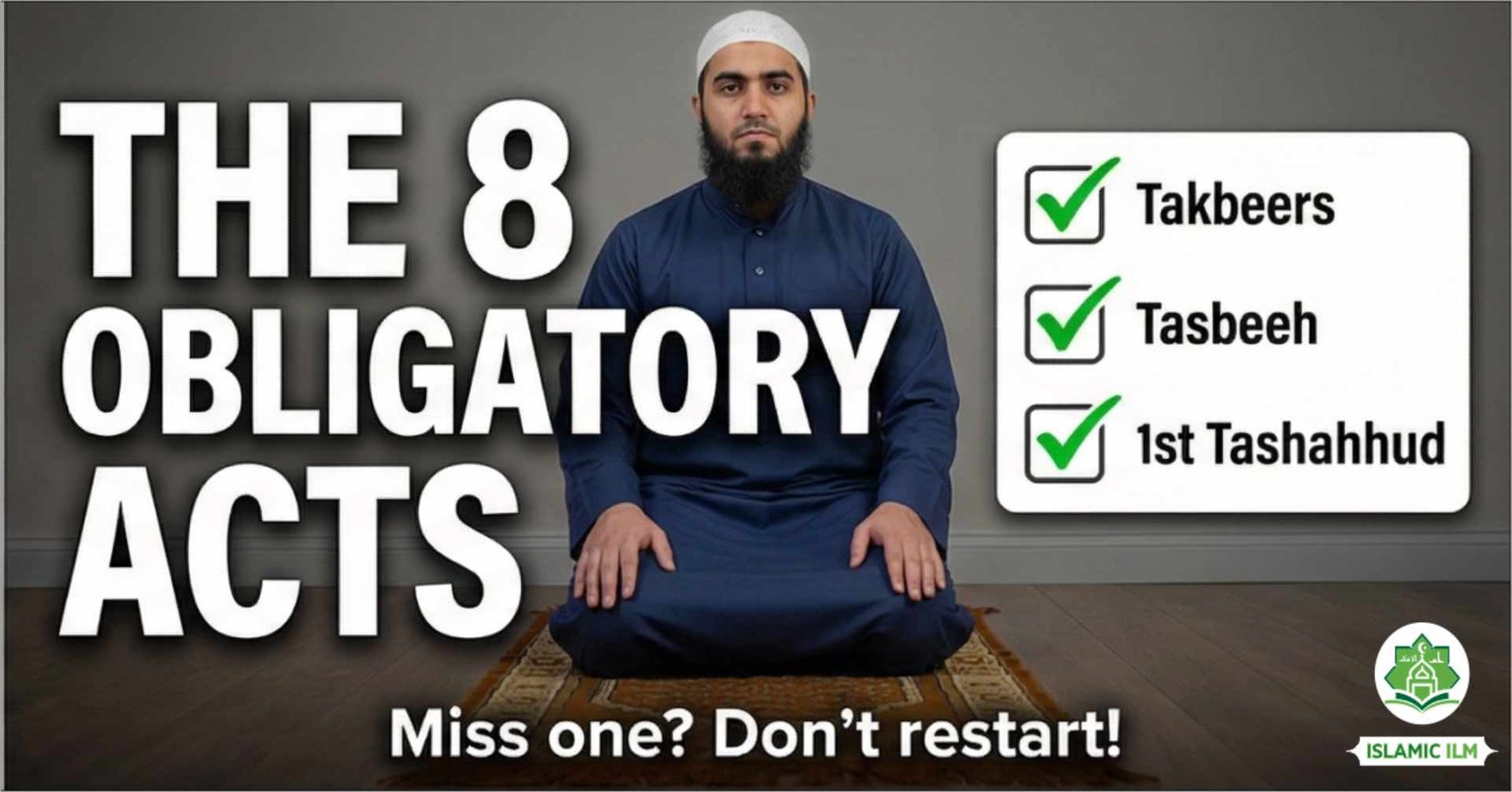
In our previous discussions, we explored the Conditions (prerequisites) and the Pillars (essential parts) of Salah. Today, we delve into the Obligatory Parts of Prayer (Wajibat al-Salah).
Understanding these is crucial for every Muslim, as they form the “connective tissue” of our worship. While they are of a lesser degree than the Pillars, they remain vital for the validity of your prayer.
What Makes a Part “Obligatory”?
The primary difference between a Pillar (like Sujud) and an Obligatory part (like Tasbeeh) lies in how we handle mistakes:
Deliberate Omission: If you skip an obligatory part on purpose, your prayer is invalid.
Accidental Omission: If you forget an obligatory part due to mistake or ignorance, your prayer remains valid, but you must correct it by performing the Prostration of Forgetfulness (Sujud al-Sahw) before or after the final Tasleem.
Table of Contents
Toggle1. The Takbeers of Movement (Takbeerat al-Intiqal)
Every time you move from one posture to another—such as moving from standing to bowing, or rising from prostration—you say “Allahu Akbar”.
Note: This excludes the very first Takbeer (the opening one), which is an Essential Pillar.
Abu Hurayrah (RA) narrated that he would say Takbeer every time he moved up or down, noting that his prayer most closely resembled that of the Messenger of Allah ﷺ.
2. Tasbeeh in Bowing and Prostration
Glorifying Allah during the physical acts of humility is mandatory.
In Ruku (Bowing): You must say “Subhana Rabbiy al-Azeem” (Glory be to my Lord the Most Great).
In Sujud (Prostration): You must say “Subhana Rabbiy al-A’la” (Glory be to my Lord the Most High).
How many times? Saying it once is the minimum obligation. However, the Sunnah is to say it three times, and the most perfect is to say it ten times.
3. Tasmee‘ and Tahmeed (Rising from Bowing)
When rising from the bowing position, specific phrases are required:
Tasmee‘: The Imam and the person praying alone say “Sami‘a Allahu liman hamidah” (Allah hears the one who praises Him).
Tahmeed: Once standing straight, they say “Rabbana wa laka’l-hamd” (Our Lord, and to You be praise).
For the Follower: If you are praying behind an Imam, you only need to say the Tahmeed.
4. Seeking Forgiveness Between Prostrations
While sitting briefly between the two prostrations, it is obligatory to say:
“Rabb ighfir li” (Lord forgive me).
The Prophet ﷺ would repeat this phrase twice during this specific sitting.
5. The First Tashahhud and Sitting
In prayers that consist of three or four units (like Maghrib, Zuhr, Asr, or Isha), there is a middle sitting after the second Rak’ah.
The Act: Sitting for the first Tashahhud is obligatory.
The Words: Reciting the At-tahiyyaatu… is the obligatory recitation.
If a worshipper accidentally stands up for the third Rak’ah without performing this sitting, they do not return to it; instead, they complete the prayer and perform the prostration of forgetfulness at the end.