
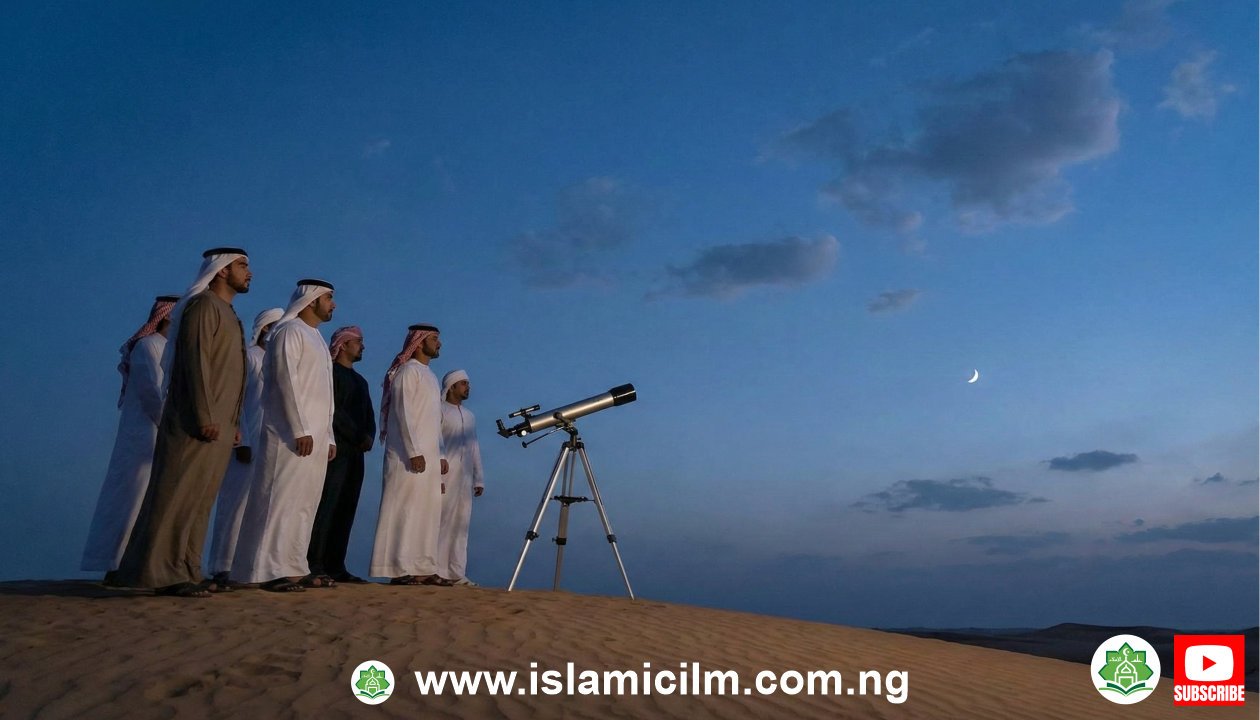
The transition into the holy month of Ramadan is a moment of deep spiritual significance, yet it is also a time of practical preparation. Unlike the solar calendar, the Islamic lunar calendar depends on the natural cycle of the heavens. For a Muslim, the start of fasting is not just a date on a calendar; it is a response to a specific celestial event: the sighting of the Hilal (the new crescent moon).
To ensure our worship begins with certainty, we must look to the Quran and the Sunnah for guidance on how the beginning and end of Ramadan are established.
Table of Contents
Toggle1. The Prophetic Foundation: “When You See It, Fast”
The primary method for proving the start of Ramadan is the physical sighting of the new moon. The Messenger of Allah ﷺ made this remarkably clear:
«When you see it, then Fast. » (Narrated by al-Bukhari and Muslim)
This command places the responsibility on the community to observe the horizon. If a single Muslim of sound character—meaning someone known for their honesty and integrity sights the moon, their testimony is sufficient to establish the start of the month for the community.
What if the sky is not clear?
Islam is a religion of ease and does not require us to guess. If the horizon is obscured by clouds, dust, or fog on the 29th of Sha’ban, we follow the Prophetic instruction:
«Fast when you see it and stop fasting when you see it, and if it is too cloudy for you to see it, then complete the month of Sha’ban as thirty days.» (Narrated by al-Bukhari and Muslim)
Because a lunar month can only be 29 or 30 days, we simply complete the 30th day of Sha’ban, and the next day becomes the 1st of Ramadan by default.
2. Each Land and Its Moon Sighting
A common question in our modern, globalized world is whether a sighting in one part of the world applies to everyone. According to the most likely correct scholarly view, each land has its own moon sighting.
This is supported by the general meaning of the Quranic verse:
{So, whoever sights [the new moon of] the month, let him fast it} (Surat al-Baqarah 2:185)
The Lesson of Ibn Abbas (RA)
In Sahih Muslim, Kurayb narrated that while he was in Syria, they sighted the moon on a Friday. When he returned to Madinah and spoke with Ibn Abbas (RA), he found that the people of Madinah had sighted it on Saturday. Even though Kurayb confirmed the Syrian sighting, Ibn Abbas insisted they would continue fasting until they reached 30 days or saw the moon in Madinah, stating:
“No; this is what the Messenger of Allah ﷺ instructed us to do.”
This establishes that geographic differences in the moon’s visibility are recognized and respected in Islamic law.
3. Technology vs. Calculation: A Vital Distinction
In an age of advanced science, it is important to understand what is—and is not—permissible regarding technology and moon sighting:
• Astronomical Equipment (Permissible): It is permissible to use telescopes, binoculars, and other equipment to help sight the moon. These tools simply enhance the human eye’s ability to “see” the moon, which aligns with the Prophetic command.
• Astronomical Calculations (Not Permissible for Starting Fast): Relying solely on pre-calculated math to determine the start of the month, without any physical sighting, is not permissible for establishing the beginning or end of Ramadan. The act of “witnessing” or “sighting” is a fundamental part of the ritual.
4. Closing the Month: Sighting the Moon of Shawwal
Just as we enter the month through sighting, we exit it through sighting. However, there is a slight difference in the requirement for testimony:
1. The Testimony of Two: To end Ramadan and celebrate Eid al-Fitr, the testimony of two Muslims of good character is required to confirm the sighting of the new moon of Shawwal.
2. Completing the Month: If the moon of Shawwal is not sighted on the 29th night of Ramadan, it is obligatory to complete Ramadan as thirty days.
Conclusion
Sighting the new moon of Ramadan is a practice that binds the Ummah to the rhythms of Allah’s creation. By following these established rules—relying on character-driven testimony, respecting local sightings, and utilizing technology while staying true to the Sunnah, we can begin our fast with confidence and spiritual peace.